Artificial Intelligence (AI) is no longer a futuristic technology reserved for large corporations. In 2026, AI has become one of the most powerful tools available to small businesses, helping entrepreneurs automate repetitive tasks, improve customer experiences, increase productivity, and grow revenue faster than ever before.
From content creation and marketing automation to customer support and project management, AI tools are transforming how businesses operate. Small business owners who embrace AI can compete with larger organizations while reducing costs and saving valuable time.
In this guide, we’ll explore the 18 best AI tools for small business growth in 2026, including their key features, benefits, pricing, and ideal use cases.
Why Small Businesses Need AI in 2026
Running a small business often means managing multiple responsibilities simultaneously. Owners frequently handle marketing, customer service, sales, operations, and administration with limited resources.
AI helps solve these challenges by:
- Automating repetitive tasks
- Reducing operational costs
- Improving customer support
- Increasing employee productivity
- Enhancing marketing performance
- Generating valuable business insights
- Streamlining workflows
Businesses that effectively integrate AI can save hundreds of hours annually while improving efficiency and profitability.
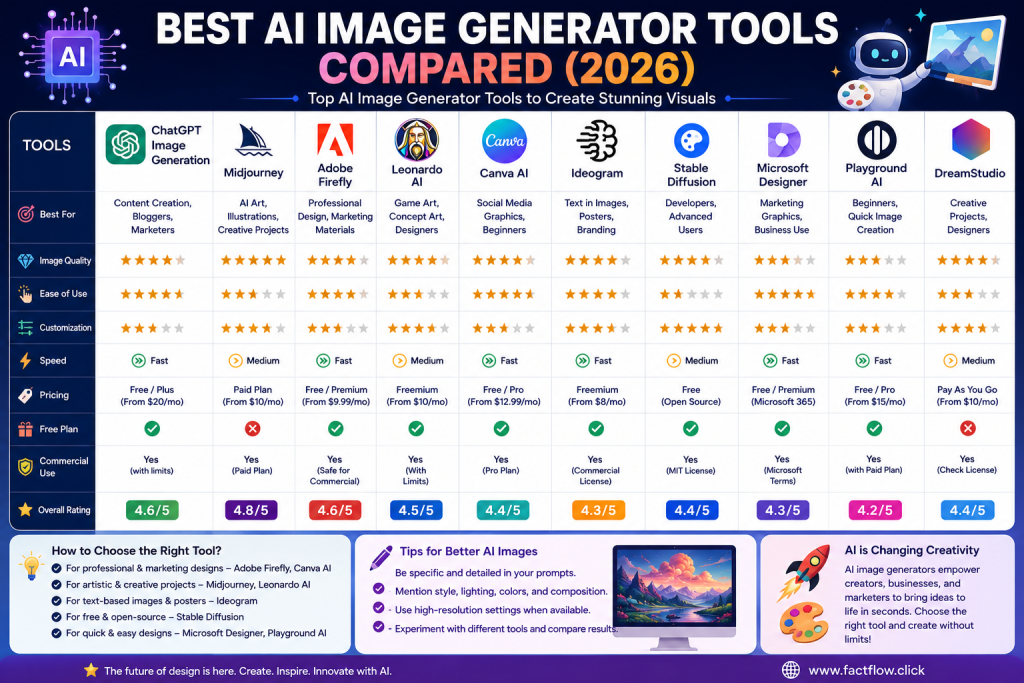
Quick Comparison of the 18 Best AI Tools For Small Business Growth
| Tool | Best For | Free Plan | Starting Price |
|---|---|---|---|
| ChatGPT | Content & Research | Yes | Premium Available |
| Claude | Writing & Analysis | Yes | Premium Available |
| Jasper AI | Marketing Content | No | Paid Plans |
| Grammarly | Writing Improvement | Yes | Premium Available |
| Canva AI | Design Creation | Yes | Premium Available |
| Midjourney | AI Images | No | Subscription |
| HubSpot AI | CRM & Marketing | Yes | Varies |
| Salesforce Einstein | Sales Insights | No | Enterprise Plans |
| Notion AI | Productivity | Yes | Premium Available |
| ClickUp AI | Project Management | Yes | Premium Available |
| Zapier AI | Automation | Yes | Premium Available |
| Synthesia | AI Videos | No | Subscription |
| Pictory | Video Marketing | No | Subscription |
| Surfer SEO | Content Optimization | No | Paid Plans |
| Semrush AI Tools | SEO & Marketing | Limited | Paid Plans |
| Tidio AI | Customer Support | Yes | Premium Available |
| Intercom AI | Customer Engagement | No | Subscription |
| Microsoft Copilot | Workplace Productivity | No | Subscription |
1. ChatGPT

ChatGPT remains one of the most versatile AI tools available for businesses.
Key Features
- Content creation
- Email drafting
- Customer support assistance
- Research and analysis
- Brainstorming ideas
- Marketing copy generation
Best For
Small businesses looking for an all-in-one AI assistant.
Benefits
ChatGPT can significantly reduce the time spent on content writing, customer communication, and research tasks.
2. Claude
Claude is known for producing highly accurate and natural long-form content.
Key Features
- Long form article writing
- Business analysis
- Research summaries
- Document review
- Strategic planning
Best For
Businesses creating detailed reports, guides, and documentation.
Benefits
Claude excels at handling large amounts of information while maintaining context and accuracy. If you’re also looking to speed up your content workflow, pairing Claude with the best free AI writing tools can help you produce polished drafts even faster without added cost.
3. Jasper AI
Jasper is designed specifically for marketers.
Key Features
- Marketing content generation
- Social media creation
- Ad copywriting
- Email marketing
- Brand voice customization
Best For
Marketing teams and agencies.
Benefits
Businesses can create large volumes of marketing content in significantly less time.
4. Grammarly
Grammarly helps businesses maintain professional communication.
Key Features
- Grammar correction
- Tone suggestions
- Clarity improvements
- AI writing assistance
Best For
Professional communication and business writing.
Benefits
Improves credibility by ensuring error-free communication.
5. Canva AI
Canva AI simplifies graphic design for non-designers.
Key Features
- AI image generation
- Presentation creation
- Social media graphics
- Brand kits
- Video editing
Best For
Small businesses creating visual marketing content.
Benefits
Reduces the need for expensive design services.
6. Midjourney
Midjourney creates stunning AI-generated visuals.
Key Features
- High-quality image generation
- Product mockups
- Marketing visuals
- Concept artwork
Best For
Creative businesses and marketers.
Benefits
Generates professional images quickly and affordably.
7. HubSpot AI

HubSpot integrates AI into customer relationship management.
Key Features
- Lead management
- Marketing automation
- Sales forecasting
- Customer analytics
Best For
Growing businesses focused on customer acquisition.
Benefits
Improves lead conversion and customer retention.
8. Salesforce Einstein
Salesforce Einstein uses AI to improve sales performance.
Key Features
- Predictive analytics
- Sales forecasting
- Lead scoring
- Customer insights
Best For
Businesses with larger sales operations.
Benefits
Helps teams prioritize high value opportunities.
9. Notion AI
Notion AI combines productivity and knowledge management.
Key Features
- Note generation
- Task management
- Document creation
- Team collaboration
Best For
Remote teams and startups.
Benefits
Centralizes information and improves team efficiency.
10. ClickUp AI
ClickUp AI enhances project management.
Key Features
- Task automation
- Workflow management
- AI writing tools
- Productivity tracking
Best For
Teams managing multiple projects.
Benefits
Reduces administrative workload and improves organization.
11. Zapier AI
Zapier connects different software tools and automates workflows.
Key Features
- App integrations
- Workflow automation
- AI-powered actions
- Process optimization
Best For
Businesses using multiple digital platforms.
Benefits
Eliminates repetitive manual tasks.
12. Synthesia
Synthesia allows businesses to create AI-generated videos.
Key Features
- AI avatars
- Video generation
- Training videos
- Marketing videos
Best For
Training and content marketing.
Benefits
Produces professional videos without expensive equipment.
13. Pictory
Pictory converts text into engaging videos.
Key Features
- Blog to video conversion
- Video editing
- Caption generation
- Social media video creation
Best For
Content marketers.
Benefits
Repurposes written content into video content efficiently.
14. Surfer SEO
Surfer SEO helps improve search engine rankings.
Key Features
- Content optimization
- Keyword research
- SERP analysis
- SEO auditing
Best For
Businesses focused on organic traffic.
Benefits
Improves visibility in search engines and drives more visitors.
15. Semrush AI Tools
Semrush offers AI powered SEO and marketing solutions.
Key Features
- Keyword research
- Competitor analysis
- Content creation
- SEO monitoring
Best For
Digital marketers and website owners.
Benefits
Provides comprehensive insights for improving online visibility.
16. Tidio AI
Tidio combines live chat and AI powered customer support.
Key Features
- AI chatbot
- Live chat
- Customer support automation
- Lead generation
Best For
E commerce businesses.
Benefits
Provides instant responses and improves customer satisfaction.
17. Intercom AI
Intercom helps businesses automate customer interactions.
Key Features
- AI customer service
- Help desk automation
- Customer engagement
- Support workflows
Best For
Businesses with growing customer support demands.
Benefits
Reduces support costs while maintaining excellent service.
18. Microsoft Copilot
Microsoft Copilot integrates AI into everyday business software.
Key Features
- AI-powered Word assistance
- Excel automation
- Meeting summaries
- Email drafting
Best For
Businesses using Microsoft 365.
Benefits
Improves productivity across daily business operations.
How to Choose the Right AI Tool for Your Business
With so many options available, selecting the right AI solution requires careful consideration.
1.Define Your Goals
Identify the specific problems you want AI to solve. Examples include:
- Improving customer support
- Increasing sales
- Enhancing marketing
- Automating workflows
2.Consider Your Budget
Many AI tools offer free plans, but premium features often require subscriptions. Evaluate the return on investment before committing.
3.Evaluate Ease of Use
Choose tools that your team can learn and implement quickly.
4.Check Integrations
Ensure the AI solution integrates with your existing software stack.
5.Think About Scalability
Select tools that can grow alongside your business.
Benefits of Using AI Tools for Small Businesses
1.Increased Productivity
AI automates repetitive tasks, allowing employees to focus on strategic work.
2.Lower Operating Costs
Businesses can reduce labor costs while maintaining efficiency.
3.Better Customer Service
AI chatbots provide instant support and improve customer satisfaction.
4.Improved Marketing Results
AI helps create personalized campaigns that generate better engagement.
5.Faster Decision Making
Advanced analytics provide valuable business insights.
6.Greater Competitive Advantage
Businesses adopting AI early often outperform competitors.
Common Mistakes to Avoid
Many businesses fail to maximize AI’s potential due to avoidable mistakes.
1.Using Too Many Tools
Focus on solving specific business problems rather than adopting every available AI platform.
2.Ignoring Staff Training
Employees need proper training to use AI effectively.
3.Expecting Instant Results
AI implementation takes time and optimization.
4.Poor Data Management
AI systems perform best when supported by accurate data.
5.Lack of Strategy
Always align AI investments with business objectives.
The Future of AI for Small Businesses
AI technology continues to evolve rapidly. To stay ahead, it’s worth keeping up with the latest artificial intelligence news so your business can adapt to emerging tools and trends as soon as they surface.
Several trends are expected to shape the future:
1.AI Agents
Autonomous AI assistants will manage increasingly complex workflows.
2.Hyper Personalization
Businesses will deliver highly customized customer experiences.
3.Predictive Analytics
AI will help predict customer behavior and market trends.
4.Voice AI
Voice-based interactions will become more common in business operations.
5.Autonomous Business Processes
Many routine tasks will become fully automated, reducing operational overhead.
Businesses that adopt these innovations early will be better positioned for long-term success.
Conclusion
AI has become an essential growth driver for small businesses in 2026. Whether you need content creation, customer support, marketing automation, project management, or sales optimization, there is an AI solution designed to help.
Tools like ChatGPT, Claude, HubSpot AI, Canva AI, Zapier, and Microsoft Copilot can save time, reduce costs, and improve productivity across every area of your business. Beyond the tools covered here, exploring the best AI productivity tools can help you discover additional options that fit your specific workflow and team size.
The most successful businesses are not necessarily those with the largest budgets, but those that effectively leverage technology to work smarter. By choosing the right AI tools and implementing them strategically, small businesses can compete at a much higher level and achieve sustainable growth in the years ahead.