
Artificial Intelligence (AI) has moved from being a futuristic idea to becoming a practical part of everyday life. Many people use AI every day without even realizing it. From smartphones and search engines to online shopping, education, entertainment, and workplace tools, AI is helping people complete tasks faster and make better use of information.
As AI technology continues to develop, its influence on our daily routines is expected to grow. Understanding how AI works and how it is being used can help people take advantage of its benefits while also using it responsibly.
Table of Contents
- What Is Artificial Intelligence?
- AI in Smartphones
- AI in Search Engines
- AI in Education
- AI at Work
- AI in Online Shopping
- AI in Transportation
- AI in Healthcare
- AI in Entertainment
- Benefits of AI in Everyday Life
- Challenges of Artificial Intelligence
- How to Use AI Responsibly
- The Future of AI
- Conclusion
- Frequently Asked Questions
What Is Artificial Intelligence?
Artificial Intelligence is a branch of technology that enables computers and software to perform tasks that usually require human intelligence. These tasks can include understanding language, recognizing images, analyzing information, identifying patterns, making predictions, and solving problems.
AI systems can process large amounts of data and use patterns in that data to produce useful results. Machine learning, natural language processing, computer vision, and generative AI are some examples of technologies associated with modern AI.
Today, AI is being incorporated into many digital products and services, making it easier for ordinary users to benefit from advanced technology.
AI in Smartphones
Smartphones are one of the most common ways people interact with AI. Modern smartphones use AI-powered features for photography, voice recognition, security, text suggestions, and personalized experiences.
For example, AI can help a smartphone camera recognize scenes and objects and automatically adjust settings. Facial recognition can also be used to unlock devices, while predictive text can suggest words as users type messages.
Voice assistants are another example. They can understand spoken requests and help users search for information, set reminders, manage schedules, or perform other simple tasks.
AI in Search Engines
Search engines use intelligent algorithms to understand what users are looking for and provide relevant information. AI can help interpret the meaning behind search queries rather than simply matching individual words.
AI-powered search features can also summarize information, identify relevant topics, and provide more personalized results.
However, users should still evaluate online information carefully. AI-generated or AI-assisted results can sometimes contain errors, so important information should be checked against reliable sources.
AI in Education
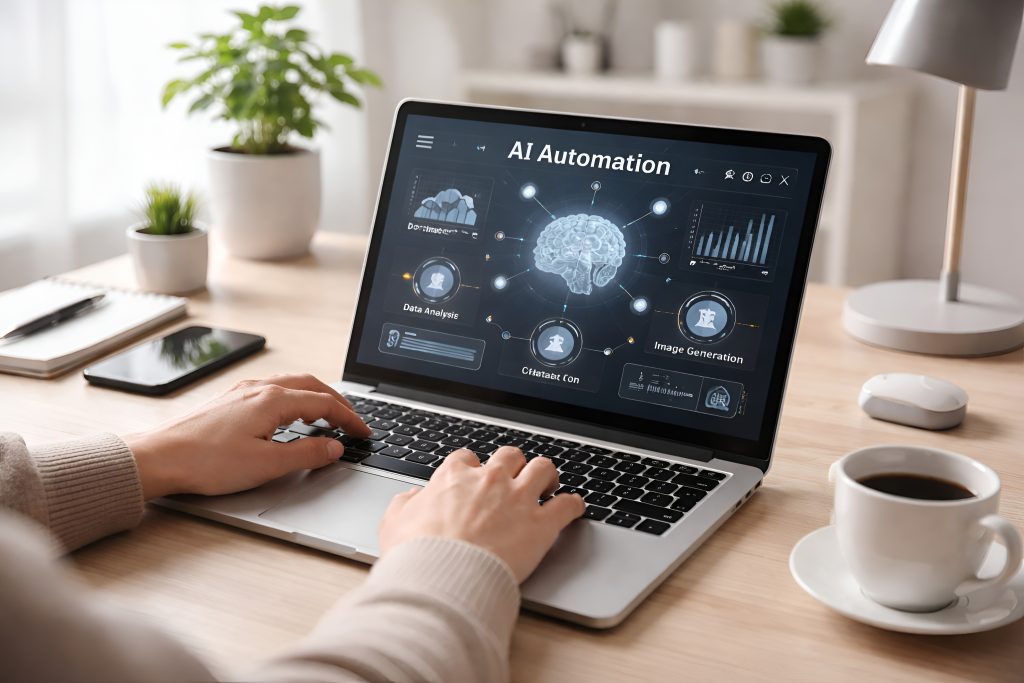
Artificial Intelligence is changing the learning experience for students and educators. AI tools can explain complex subjects, generate practice questions, provide writing assistance, and help students organize study materials.
For example, a student struggling with mathematics can use an AI tool to receive a step-by-step explanation of a concept. Language learners can use AI to practice vocabulary, grammar, and conversation.
Teachers can also use AI to create lesson ideas, organize information, and develop educational activities.
Despite these benefits, students should use AI as a learning tool rather than simply copying its answers. Developing independent thinking and understanding the subject remains essential.
AI at Work
AI is becoming increasingly useful in the workplace. Businesses can use AI to automate repetitive tasks, analyze data, organize information, assist customers, and improve productivity.
For example, AI can help employees summarize documents, generate ideas, organize emails, prepare reports, and analyze large datasets.
Automation can save time by handling routine activities, allowing employees to focus on tasks that require creativity, communication, critical thinking, and decision-making.
AI is therefore changing many jobs rather than simply eliminating the need for human workers. Employees who learn how to use AI effectively may be better prepared for the changing workplace.
AI in Online Shopping
AI plays an important role in e-commerce. Online stores can analyze customer behavior and recommend products that may be relevant to individual shoppers.
When an online store displays recommendations such as products you may like or items frequently purchased together, AI and data analysis may be involved in creating those suggestions.
Businesses can also use AI to analyze customer feedback, predict demand, manage inventory, and improve customer service.
For consumers, these technologies can make it easier to discover products. At the same time, users should be aware that personalized recommendations are often based on their online activity and preferences.
AI in Transportation
Transportation and navigation services also benefit from AI. Navigation applications can analyze traffic conditions and suggest routes that may reduce travel time.
AI is also being used in driver-assistance technologies. Modern vehicles can include features that help detect objects, maintain lanes, monitor surroundings, and provide warnings to drivers.
Self-driving vehicle technology is another area of AI research. Although autonomous transportation continues to develop, it demonstrates how AI could influence the future of mobility.
AI in Healthcare
AI has the potential to support healthcare professionals in many ways. AI systems can assist with analyzing medical images, organizing patient information, identifying patterns in data, and supporting research.
AI-powered health applications can also help users track activities such as exercise, sleep, and other general wellness information.
However, AI should not replace qualified medical professionals. Medical decisions should be based on appropriate professional advice, especially when dealing with serious symptoms or conditions.
AI in Entertainment
Entertainment platforms use AI to personalize the content users see. Streaming services can recommend movies, shows, music, and other content based on viewing or listening behavior.
AI is also being used in video games, photography, music production, animation, and digital content creation.
For creators, AI can provide ideas, assist with editing, generate drafts, and automate certain parts of the creative process. Human creativity and judgment are still important for producing meaningful and original work.
Benefits of AI in Everyday Life
AI provides several advantages that can make daily activities easier and more efficient.
1. Saves Time
AI can automate repetitive tasks and provide quick access to information, allowing people to spend more time on important activities.
2. Improves Productivity
AI tools can help users organize information, create drafts, analyze data, and complete routine tasks.
3. Personalizes Experiences
Many digital services use AI to provide recommendations based on individual interests and behavior.
4. Supports Learning
AI can provide explanations, examples, practice exercises, and educational assistance.
5. Helps Businesses
Businesses can use AI for customer support, marketing, data analysis, automation, and decision-making.
6. Makes Technology More Accessible
AI-powered voice recognition, translation, image recognition, and other features can make digital technology easier for many people to use.
Challenges of Artificial Intelligence
Although AI offers many benefits, it also creates challenges that should not be ignored.
Privacy
AI systems often rely on data. Users should understand what information they are sharing and avoid providing sensitive personal information to untrusted services.
Accuracy
AI can sometimes produce incorrect or misleading information. Important facts should always be verified.
Job Changes
Automation may change the responsibilities associated with certain jobs. Workers may need to develop new digital skills to adapt to changing workplaces.
Misinformation
AI can be used to create convincing but false text, images, audio, and video. Users should be careful when consuming information online.
Overdependence
Relying too heavily on AI can reduce opportunities to develop independent problem-solving and critical-thinking skills.
How to Use AI Responsibly
Using AI responsibly means understanding both its capabilities and limitations.
Before using an AI tool, consider what information you are sharing. Avoid entering passwords, financial details, confidential documents, or other sensitive information into unknown services.
It is also important to verify AI-generated information, especially when making financial, educational, professional, legal, or health-related decisions.
AI should be viewed as an assistant rather than an unquestionable authority. Combining AI tools with human judgment can lead to better and more reliable results.
The Future of AI
Artificial Intelligence is likely to become even more integrated into everyday life. Future AI systems may provide more personalized digital assistance, improve educational experiences, support businesses, and create new ways of interacting with technology.
Smart homes, transportation, healthcare, communication, and online services may all become more intelligent as AI develops.
The future of AI will depend not only on technological progress but also on how people, businesses, and governments choose to use the technology. Responsible development, privacy protection, transparency, and human oversight will remain important.

Frequently Asked Questions
1. What is Artificial Intelligence?
Artificial Intelligence is technology that enables computers and software to perform tasks that normally require human intelligence, such as understanding language, recognizing patterns, analyzing information, and solving problems.
2. How is AI used in everyday life?
AI is used in smartphones, search engines, navigation apps, online shopping, education platforms, entertainment services, workplace software, and many other digital tools.
3. How does AI help students?
AI can help students understand difficult topics, create practice questions, organize study materials, improve writing, and explore new subjects.
4. Can AI improve productivity?
Yes. AI can automate repetitive tasks, organize information, assist with writing, summarize documents, analyze data, and help users complete certain tasks more efficiently.
5. Is AI safe to use?
AI can be useful when used responsibly. Users should protect sensitive information, choose trustworthy tools, and verify important information generated by AI.
6. Will AI replace human workers?
AI may automate some tasks and change certain jobs, but many roles still require human creativity, communication, critical thinking, emotional intelligence, and decision-making.
7. How does AI affect online shopping?
AI can analyze customer behavior and provide personalized product recommendations. Businesses can also use AI to improve customer service, inventory management, and marketing.
8. What are the biggest risks of AI?
Some important concerns include privacy, inaccurate information, misinformation, excessive dependence on technology, and changes to employment.
9. Can AI be used in education?
Yes. AI can support students and teachers through personalized learning, explanations, practice exercises, educational content, and productivity tools.
10. What is the future of Artificial Intelligence?
AI is expected to become increasingly integrated into everyday technology, workplaces, education, transportation, healthcare, entertainment, and online services.
Conclusion
Artificial Intelligence is already changing everyday life. It helps people communicate, search for information, learn new skills, shop online, navigate roads, work more efficiently, and enjoy personalized entertainment.
While AI offers significant benefits, it also comes with challenges involving privacy, accuracy, misinformation, and changes in the workplace. The best approach is to use AI thoughtfully, verify important information, protect personal data, and maintain human judgment.
As AI continues to evolve, learning how to use it effectively and responsibly can help individuals and businesses make the most of this rapidly developing technology.