If your business isn’t showing up when nearby customers search for what you offer, something in your local SEO setup is broken. A local SEO audit is how you find out what — before you spend another dollar on ads or content that won’t move the needle.
This guide walks through exactly how to audit your local SEO, in the order that actually matters: the things Google weighs most heavily first, then the supporting signals. You don’t need expensive software to get through most of it. A notepad, your Google Business Profile login, and about two hours will get you 80% of the way there.
Quick Answer: A local SEO audit checks five core areas — your Google Business Profile, NAP (name, address, phone) consistency across the web, online reviews, on-page local signals, and local backlinks/citations. Start with your Business Profile, since it has the single biggest impact on local pack rankings, then work outward.
What Is a Local SEO Audit?
A local SEO audit is a structured review of everything that affects how well your business ranks in local search results — the “map pack,” Google Maps, and localized organic results. It’s different from a standard SEO audit because it focuses on location-based ranking factors: your Google Business Profile, business listings across the web, proximity signals, and locally-relevant content, rather than just site-wide technical health.
The goal isn’t to produce a report for its own sake. It’s to walk away with a prioritized list of fixes ranked by how much they’ll actually move your visibility, because not every issue matters equally.
Your Google Business Profile has more influence on local pack rankings than almost anything else you control — audit it first.
Inconsistent business name, address, or phone number (NAP) across directories is one of the most common — and most fixable — local SEO problems.
Review quantity, recency, and your response rate all factor into local rankings, not just your star rating.
On-page signals (location pages, local schema, local keywords) matter, but they support your Business Profile — they don’t replace it.
A full audit should end with a prioritized action list, not just a list of problems.
Table of Contents
1. Google Business Profile (GBP) Audit
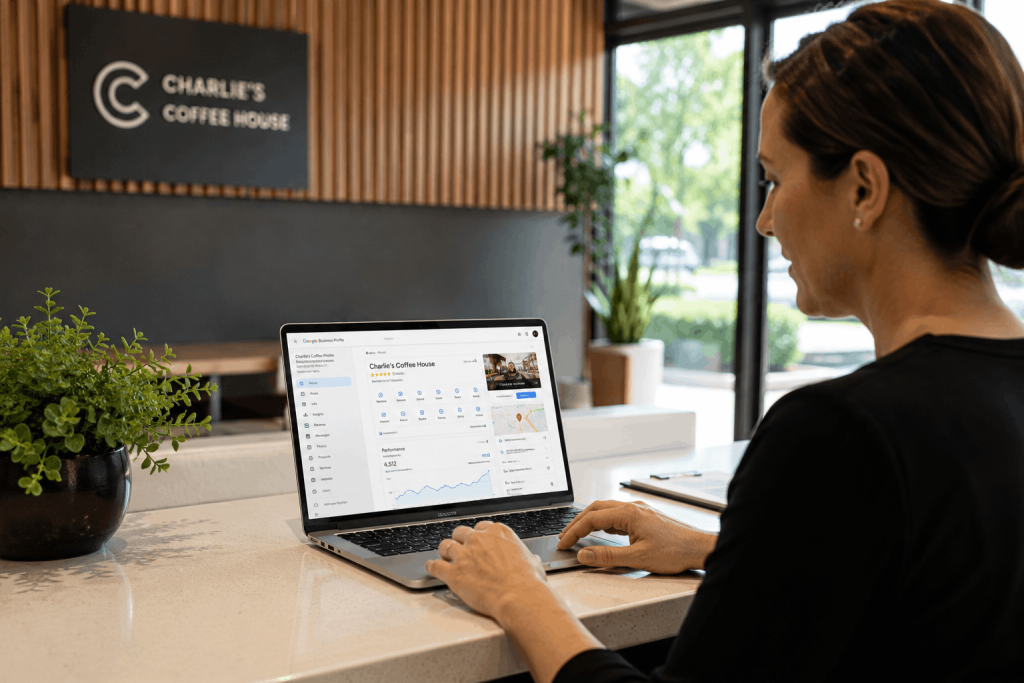
Start here. Your Google Business Profile (formerly Google My Business) is the single most direct input into whether you appear in the local map pack.
What to check:
Business name — should match your real-world signage and legal name exactly. Adding keywords to your GBP name (e.g., “Joe’s Plumbing – Best Emergency Plumber”) violates Google’s guidelines and can get a profile suspended.
Primary and secondary categories — the primary category should describe your core business as precisely as possible. Overly broad categories (“Business” instead of “Roofing Contractor”) dilute relevance.
Business description — should be clear, factual, and free of keyword stuffing.
Hours of operation — including holiday hours, which are frequently left outdated.
Service areas — correctly set if you’re a service-area business without a public storefront.
Photos — recent, real photos of the business, staff, and work performed. Stock photos hurt trust signals.
Products and services list — filled out completely, since these fields are searchable within Maps.
Q&A section — check for unanswered questions or inaccurate answers left by the public.
Booking/messaging features — enabled where relevant, since engagement features can support visibility.
Expert Insight
A profile that’s simply complete and accurate will consistently outperform one that’s keyword-optimized but incomplete. Completeness is a signal Google can verify directly; keyword tricks in the business name are a policy violation Google actively penalizes.
2. NAP Consistency and Citation Audit
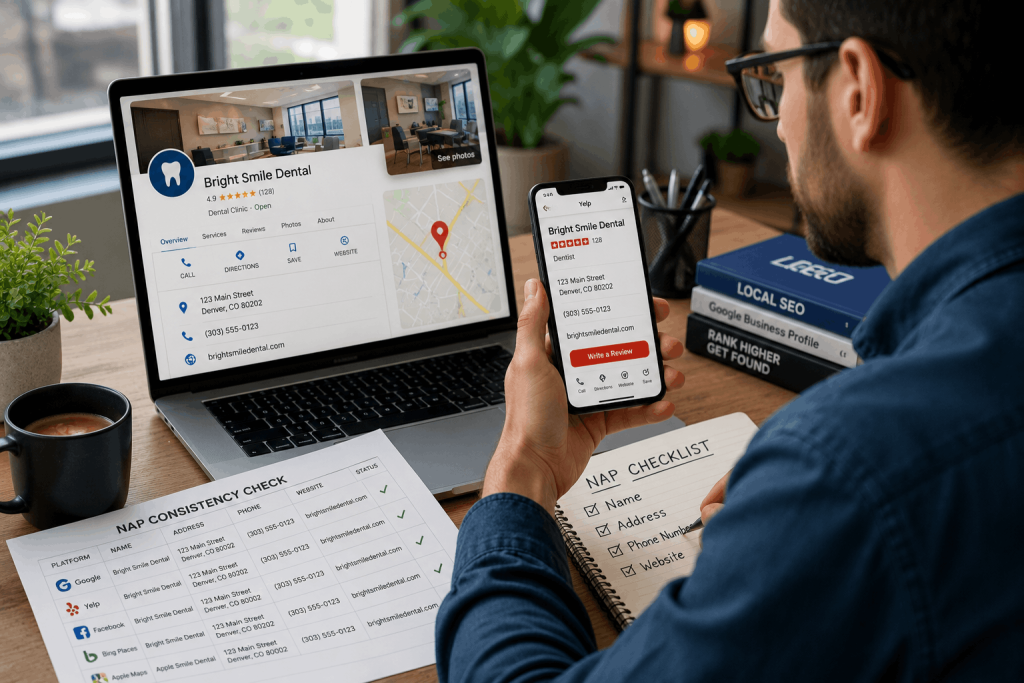
NAP stands for Name, Address, Phone number. Search engines cross-reference your NAP across the web — directories, social profiles, industry listings — to verify your business is real and where it says it is. Inconsistencies create doubt, and doubt suppresses rankings.
How to audit citations:
Search your business name plus city (e.g., “Joe’s Plumbing Austin”) and note every directory listing that appears.
Check major data aggregators and directories: Google Business Profile, Bing Places, Apple Maps/Apple Business Connect, Yelp, Facebook, industry-specific directories (e.g., Houzz for contractors, Avvo for lawyers).
Record the NAP shown on each listing in a simple spreadsheet.
Flag any mismatches: old addresses, abbreviated vs. spelled-out street types (St. vs Street), different phone numbers, or old business names from a rebrand.
Fix mismatches directly on each platform, prioritizing the highest-traffic directories first.
Definition: A citation is any online mention of your business’s name, address, and phone number, whether or not it links back to your website. Citations don’t need to be linked to count for local SEO.
3. Review Profile Audit
Reviews affect both rankings and click-through behavior. An audit here looks at more than your star average.
What to evaluate:
Factor
Why It Matters
What Good Looks Like
Review volume
Signals popularity and trust
Steady growth over time, not a one-time spike
Review recency
Signals the business is active
New reviews within the last 30–90 days
Review response rate
Signals engagement and customer service
Responses to most reviews, especially negative ones
Review platform diversity
Reduces reliance on a single source
Presence on Google, Facebook, and industry-specific sites
Keyword mentions in reviews
Can reinforce topical relevance
Customers naturally mention services/locations
Common Mistake
Buying or incentivizing fake reviews. This violates Google’s policies outright and can result in profile suspension or removal — the risk far outweighs any short-term ranking benefit.
4. On-Page Local SEO Audit
Once your Business Profile and citations are solid, check whether your website itself reinforces your local relevance.
Checklist:
Location pages — a dedicated, unique page for each physical location or service area (not duplicated templates with only the city name swapped).
NAP in the footer — consistent with your GBP listing, ideally as crawlable text rather than an image.
Title tags and meta descriptions — include your service and city naturally, without stuffing.
LocalBusiness schema markup — implemented and validated using Google’s Rich Results Test.
Embedded Google Map — on the contact page, matching your verified address.
Mobile usability and page speed — since most local searches happen on mobile devices.
Locally relevant content — blog posts, FAQs, or guides that address location-specific questions your customers actually ask.
5. Local Link and Citation Building Review
Backlinks from locally relevant, authoritative sources (local news outlets, chambers of commerce, industry associations, sponsorships) carry more local ranking weight than generic, unrelated links.
What to check:
Do you have links from local business associations or your local chamber of commerce?
Are you listed on relevant industry directories with a followed link where policy allows?
Have you earned any coverage from local news or community sites?
Are there broken or outdated citation links pointing to an old domain or address?
6. Competitor Comparison
Pull up the map pack for your top three keywords and compare your profile against the businesses currently ranking above you.
Pros and Cons of Competitor Benchmarking
Pros
Cons
Reveals realistic, achievable targets rather than guesswork
Can lead to copying tactics that don’t fit your specific business
Identifies review volume and category gaps quickly
Doesn’t account for factors you can’t see, like historical ranking data
Highlights content or service-area gaps
Time-intensive if done manually for many keywords
Local SEO Audit Checklist
☐ Business name matches signage exactly on GBP
☐ Primary category is the most specific accurate option
☐ All hours, holiday hours, and service areas are current
☐ Photos are recent and authentic
☐ NAP is identical across all major directories
☐ No duplicate or outdated GBP listings exist
☐ Review volume and response rate are healthy and growing
☐ Location pages are unique, not templated duplicates
☐ LocalBusiness schema is implemented and validated
☐ Site loads quickly and works well on mobile
☐ At least a few genuinely local backlinks exist
Tools You Can Use
Google Business Profile dashboard — free, and the primary source of truth for your listing.
Google’s Rich Results Test — free, to validate schema markup.
Google Search Console— free, to check indexing and search performance for location pages.
PageSpeed Insights — free, to check mobile speed and usability.
Paid citation and rank-tracking platforms (such as Moz Local, BrightLocal, or Semrush’s local tools) can speed up the citation-checking process, but aren’t required to complete a first-pass audit.
Conclusion
A local SEO audit isn’t a one-time task — it’s a recurring checkup. Businesses that revisit these five areas every quarter tend to catch small problems (an outdated phone number, a stale photo, a slipping review response rate) before they compound into ranking losses. Start with your Google Business Profile, since it carries the most weight, then work through citations, reviews, on-page signals, and links in that order.
Next step: Work through the checklist above this week. If you find more than two or three issues in your Google Business Profile or citations, fix those first — they typically produce the fastest visible improvement in local pack rankings.
Frequently Asked Questions
What is a local SEO audit?
It’s a review of the factors that affect how a business ranks in local search results, including its Google Business Profile, online citations, reviews, on-page signals, and local backlinks.
How often should I audit my local SEO?
Quarterly is a reasonable cadence for most small businesses; a full audit after any move, rebrand, or phone number change is essential.
Do I need paid tools to do a local SEO audit?
No. Most of the audit can be done manually using free tools like Google Business Profile, Search Console, and PageSpeed Insights. Paid tools mainly save time on citation checks across many directories.
What’s the most important part of a local SEO audit?
The Google Business Profile audit, since it has the most direct influence on whether a business appears in the local map pack.
What is NAP consistency and why does it matter?
NAP stands for Name, Address, Phone number. Consistent NAP across directories helps search engines confirm a business’s identity and location, which supports trust and rankings.
Can bad reviews hurt my local ranking?
Review sentiment alone isn’t a confirmed direct ranking factor, but review volume, recency, and response rate are associated with stronger local visibility, and poor reviews can hurt click-through rates regardless of ranking position.
How long does a local SEO audit take?
A manual audit for a single-location business typically takes two to four hours. Multi-location businesses take longer, roughly in proportion to the number of locations.
Do citations need to be linked to count?
No. Citations are counted even without a hyperlink, as long as the business name, address, and phone number are listed accurately.
What’s the difference between a local SEO audit and a regular SEO audit?
A regular SEO audit focuses on site-wide technical health and content. A local SEO audit focuses specifically on location-based ranking factors like Google Business Profile, citations, and local backlinks.
Should I fix my Google Business Profile or my website first?
Start with the Google Business Profile. It typically has a faster and more direct impact on local pack visibility than website changes alone.
ALI
Arslan Ali is an experienced digital marketing writer and content strategist with over 5 years of hands-on experience in the digital world, including SEO, social media marketing, and eCommerce website development.
They have designed content strategies for multiple Pakistani and international brands. Their work is based on Google’s E-E-A-T principles, focusing only on content that genuinely helps readers.
On FactFlow, they write about the following topics:
SEO & Google Ranking | Digital Marketing | Web Development | eCommerce & Shopify | AI Tools & Productivity