AI vs Human Content has become one of the biggest debates in digital marketing and SEO. With AI writing tools like ChatGPT, Claude, and Gemini making content creation faster than ever, many website owners wonder whether AI-generated content can outperform human-written articles on Google. The answer isn’t as simple as choosing one over the other.
Google’s primary goal is to deliver the most helpful, accurate, and trustworthy content to users. It doesn’t reward or penalize content based solely on whether it was written by AI or a human. Instead, Google evaluates quality, relevance, originality, and how well the content satisfies search intent.
In this guide, we’ll compare AI and human content across SEO, accuracy, creativity, EEAT, user experience, and overall performance. By the end, you’ll know which approach is best for improving your website rankings in 2026.
Table of Contents
- What Is AI Content?
- What Is Human-Written Content?
- AI vs Human Content: Key Differences
- Does Google Rank AI Content?
- Pros and Cons of AI Content
- Pros and Cons of Human Content
- Which Performs Better for SEO?
- Best Practices for Combining AI and Human Expertise
- FAQs
- Conclusion
What Is AI Content?
AI content is text generated by artificial intelligence using machine learning and natural language processing. Modern AI tools can create blog posts, product descriptions, emails, social media captions, and even technical documentation within minutes.
Popular AI writing tools include:
- ChatGPT
- Claude
- Gemini
- Jasper AI
- Copy.ai
- Writesonic
These tools analyze prompts and generate content based on patterns learned from large datasets.
What Is Human-Written Content?
Human-written content is created by professional writers, marketers, or subject-matter experts. Unlike AI, humans bring personal experience, emotions, critical thinking, and storytelling into their writing.
Human writers can:
- Share real-life experiences.
- Verify facts carefully.
- Adapt tone for different audiences.
- Build trust through expertise.
- Produce unique perspectives.
These qualities are especially important for topics involving health, finance, legal advice, or technical expertise.
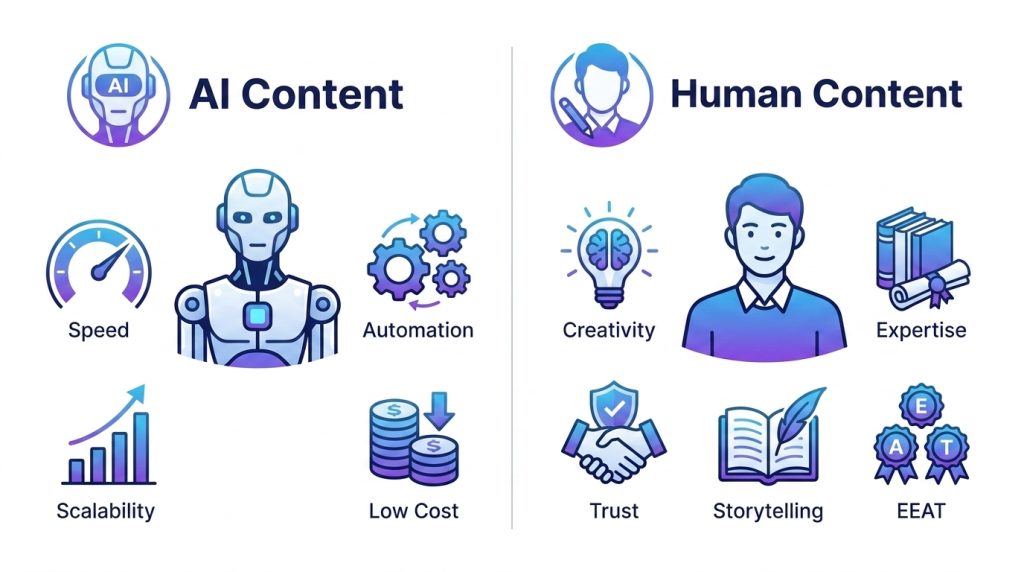
AI vs Human Content: Key Differences
| Feature | AI Content | Human Content |
|---|---|---|
| Speed | Excellent | Moderate |
| Creativity | Good | Excellent |
| Accuracy | Requires verification | Generally higher |
| Personal Experience | None | Yes |
| EEAT Signals | Limited | Strong |
| SEO Optimization | Good | Excellent |
| Cost | Lower | Higher |
| Original Insights | Limited | High |
| User Trust | Moderate | High |
| Editing Required | Yes | Minimal |
Does Google Rank AI Content?
Yes. Google can rank AI-generated content if it is helpful, accurate, original, and useful to users.
Google does not automatically penalize AI-generated content. Instead, it rewards content that:
- Answers search intent.
- Demonstrates expertise.
- Provides original value.
- Is factually accurate.
- Offers a good user experience.
Low-quality, spammy, or repetitive content—whether created by AI or humans—is unlikely to rank well.

Advantages of AI Content
1. Faster Content Creation
AI can produce a first draft in minutes, making it ideal for businesses that publish content regularly.
2. Cost-Effective
Using AI reduces content production costs, especially for startups and small businesses.
3. SEO Assistance
AI tools can suggest keywords, headings, meta descriptions, and content structures to improve on-page SEO.
4. Scalable
Businesses can create multiple articles, product descriptions, or landing pages quickly without expanding their writing team.
5. Great for Brainstorming
AI helps generate topic ideas, outlines, and content briefs, saving time during the planning stage.
Disadvantages of AI Content
Despite its benefits, AI has limitations.
Lack of Real Experience
AI cannot share firsthand experiences or personal opinions.
Occasional Inaccuracies
AI-generated information may contain outdated or incorrect facts, making human review essential.
Generic Writing
Without proper editing, AI content can sound repetitive or lack originality.
Limited Emotional Connection
AI struggles to replicate genuine human emotion, storytelling, and empathy.
Advantages of Human Content
Better Storytelling
Humans naturally create engaging stories that connect with readers on an emotional level.
Stronger EEAT
Human experts can demonstrate real-world experience, expertise, authority, and trustworthiness.
Higher Credibility
Readers often trust content written by experienced professionals, especially for complex or sensitive topics.
Original Ideas
Human writers bring creativity, unique opinions, and fresh insights that AI cannot fully replicate.
Disadvantages of Human Content
Higher Cost
Hiring experienced writers is more expensive than using AI tools.
Slower Production
Researching, writing, editing, and proofreading quality content takes time.
Limited Scalability
Producing large volumes of content requires bigger teams and greater resources.
Which Performs Better for SEO?
The answer depends on content quality, not the writing method.
AI-generated content performs well when:
- Properly researched.
- Edited by humans.
- Fact-checked.
- Optimized for search intent.
- Updated regularly.
Human-written content performs better when:
- Personal experience matters.
- Trust and authority are important.
- Original research is required.
- Complex topics need expert analysis.
For long-term SEO success, the strongest strategy is to combine AI’s efficiency with human expertise.
Best Practice: Combine AI and Human Expertise
The most effective content strategy in 2026 is a hybrid workflow:
- Use AI for keyword research and topic ideas.
- Generate a structured first draft.
- Add personal insights, examples, and expert opinions.
- Verify all facts and statistics.
- Improve readability and flow.
- Optimize headings, meta tags, and internal links.
- Proofread before publishing.
This approach helps create content that is both efficient and valuable.
Tips for Creating SEO-Friendly Content
- Focus on user intent before keywords.
- Write clear and descriptive headings.
- Use short paragraphs for readability.
- Add internal links to related articles.
- Include relevant images with descriptive alt text.
- Update older content regularly.
- Avoid keyword stuffing.
- Provide practical examples and actionable advice.
AI Content vs Human Content: Which Should You Choose?
If your goal is to publish content quickly while maintaining quality, AI is an excellent assistant.
If your goal is to build long-term authority, trust, and strong EEAT signals, human expertise remains essential.
The best-performing websites use AI to improve productivity while relying on human editors to ensure accuracy, originality, and usefulness.
Frequently Asked Questions
Is AI-generated content bad for SEO?
No. AI-generated content can rank well if it is accurate, original, and helpful.
Does Google penalize AI content?
Google does not penalize content simply because AI helped create it. Quality is what matters most.
Can ChatGPT write SEO articles?
Yes. ChatGPT can create SEO-friendly drafts, but human editing improves accuracy and overall quality.
Which is better for SEO: AI or human content?
Human-edited content generally performs better because it offers stronger expertise, originality, and trust.
Should bloggers use AI?
Yes, but AI should assist the writing process rather than replace human expertise.
Is AI content detectable?
Some tools attempt to identify AI-generated writing, but detection methods are not always reliable.
How can I improve AI-generated content?
Add real examples, verify facts, rewrite repetitive sections, and include your own insights to make the content more valuable.
Can AI replace human writers?
AI can speed up content creation, but it cannot fully replace human creativity, critical thinking, and firsthand experience.
Conclusion
The debate over AI vs Human Content isn’t about choosing one over the other—it’s about using each where it excels. AI is unmatched for speed, idea generation, and productivity, while human writers provide the creativity, expertise, and authenticity that build trust with readers and align with Google’s EEAT principles.
For the best SEO results in 2026, adopt a hybrid strategy: let AI handle research and drafting, then refine the content with human editing, fact-checking, and unique insights. This balanced approach creates high-quality, helpful content that satisfies users, supports long-term rankings, and strengthens your website’s authority in search results.