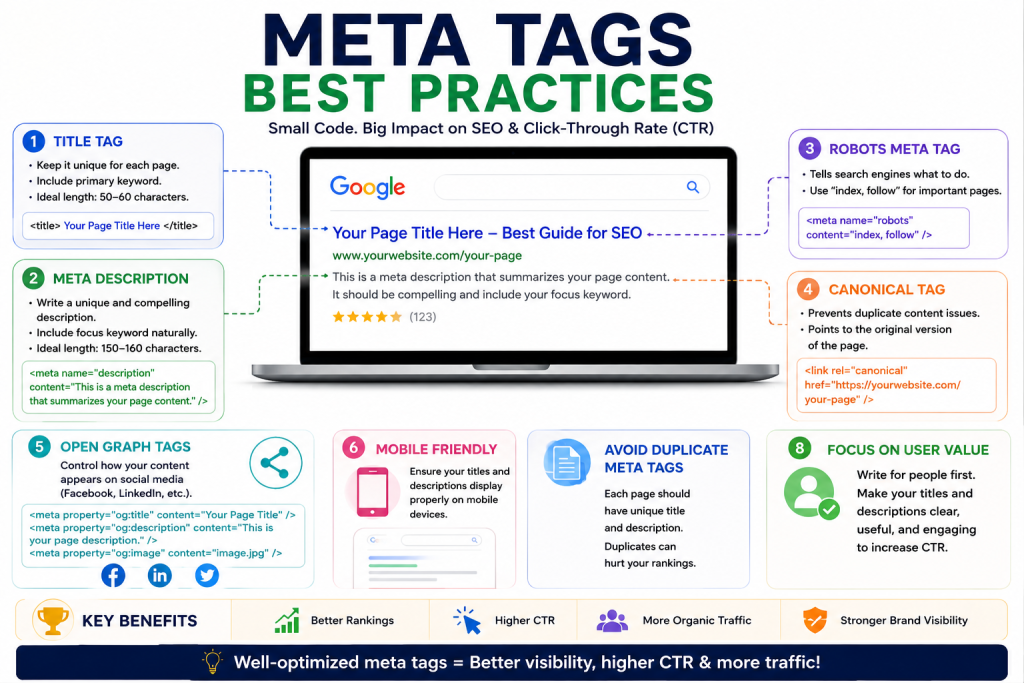
Following proven Best Practices for Meta Tags is one of the simplest ways to improve your website’s SEO performance. Although meta tags are only small pieces of HTML code, they help search engines understand your content and influence how your pages appear in search results. Well-optimized meta tags can increase your click-through rate (CTR), improve user experience, and support higher organic rankings over time. The following best practices will help you create SEO-friendly meta tags that align with Google’s recommendations.
1. Write a Unique Title Tag for Every Page
Every page on your website should have a different title tag. Duplicate titles confuse search engines and make it harder for users to understand the purpose of each page.
Good Example:
- Home: Professional Local SEO Services | FactFlow
- Blog: Meta Tags SEO Best Practices: Complete Guide for Better Rankings
2. Keep Title Tags Under 60 Characters
Google usually displays between 50–60 characters of a title tag. Longer titles may be truncated in search results.
Recommended Length:
- 50–60 characters
3. Write Compelling Meta Descriptions
Your meta description should summarize the page while encouraging users to click.
Include:
- Primary keyword
- Clear value
- Action words
- Natural language
Example:
Learn Meta Tags SEO Best Practices with practical examples, expert tips, and proven strategies to improve rankings and increase organic traffic.
4. Use Your Primary Keyword Naturally
Place your focus keyword near the beginning of your title whenever possible.
Don’t force keywords repeatedly.
Google prefers natural language over keyword stuffing.
5. Avoid Duplicate Meta Descriptions
Each page should have its own description.
Duplicate descriptions reduce page uniqueness.
6. Optimize for Mobile Users
Always preview your title and description on mobile devices.
Many searches happen on smartphones.
7. Add Open Graph Meta Tags
These improve how your pages appear when shared on Facebook and LinkedIn.
Include:
- og:title
- og:description
- og:image
8. Configure Robots Meta Tags Correctly
Most pages should use:
<meta name="robots" content="index,follow">Only block pages that shouldn’t appear in search results.
9. Use Canonical Tags
Canonical tags prevent duplicate content problems.
Every important page should reference itself or its preferred version.
10. Update Meta Tags Regularly
SEO isn’t a one-time task.
Review your title tags and descriptions every few months to improve CTR and keep them relevant.
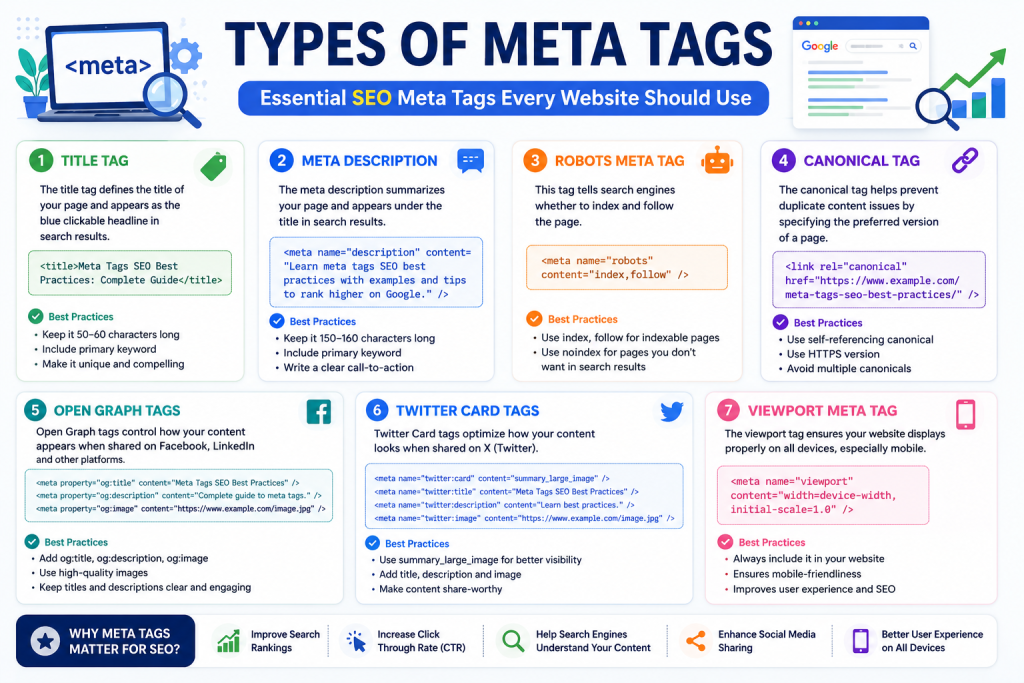
Common Meta Tag Mistakes
Avoid these common mistakes:
❌ Keyword stuffing
❌ Duplicate title tags
❌ Duplicate descriptions
❌ Missing title tags
❌ Missing meta descriptions
❌ Titles longer than 60 characters
❌ Descriptions longer than 160 characters
❌ Blocking important pages using robots tags
❌ Forgetting canonical tags
❌ Ignoring Open Graph tags
Expert SEO Tips
Experienced SEO professionals recommend:
Write for People First
Your title should attract real users, not just search engines.
Include Numbers
Examples:
- 15 Meta Tag Tips
- 10 SEO Mistakes
Numbers often improve CTR.
Use Power Words
Examples:
- Complete
- Ultimate
- Proven
- Simple
- Easy
- Expert
- Best
Match Search Intent
If users search for a guide, provide a complete guide.
If they search for a checklist, provide a checklist.
Test Different Titles
If a page receives impressions but few clicks, update the title and description to make them more appealing.
Real-Life Example
A digital marketing agency published a blog about technical SEO but used the generic title “SEO Guide.” The page received impressions but very few clicks.
The agency updated the title to “Meta Tags SEO Best Practices: Complete Guide for Better Rankings” and rewrote the meta description to clearly explain the article’s value.
Within a few weeks, the page’s click-through rate improved because users could better understand what the article offered. While rankings depend on many factors, improving search snippets often helps attract more qualified visitors.
Comparison Table
| Feature | Good Practice | Poor Practice |
|---|---|---|
| Title Tag | Unique, keyword-focused | Duplicate titles |
| Meta Description | Clear and engaging | Missing or copied |
| Robots Tag | Index important pages | Block valuable pages |
| Canonical Tag | Self-referencing | Missing |
| Open Graph | Added | Not configured |
| Mobile Optimization | Optimized | Ignored |
Pros and Cons
Pros
- Improves search visibility
- Increases click-through rate
- Helps search engines understand pages
- Supports social sharing
- Enhances user experience
- Strengthens overall SEO
Cons
- Requires regular updates
- Doesn’t guarantee higher rankings by itself
- Poor implementation can reduce performance
Frequently Asked Questions
1. What are meta tags?
Meta tags are HTML elements that provide information about a webpage to search engines and browsers.
2. Are meta tags still important?
Yes. They help search engines understand your content and improve click-through rates.
3. Does the meta description affect rankings?
Not directly, but it influences user clicks, which can improve overall SEO performance.
4. What is the ideal title tag length?
Around 50–60 characters.
5. What is the ideal meta description length?
Around 150–160 characters.
6. Should every page have unique meta tags?
Yes. Every page should have a unique title and description.
7. Are meta keywords still used by Google?
No. Google no longer uses the meta keywords tag as a ranking factor.
8. What is a canonical tag?
It tells search engines which version of a page is the preferred version.
9. Why are Open Graph tags important?
They improve how your pages appear when shared on social media.
10. Can Rank Math generate meta tags?
Yes. Rank Math makes it easy to create and optimize SEO titles, meta descriptions, and other important meta tags.
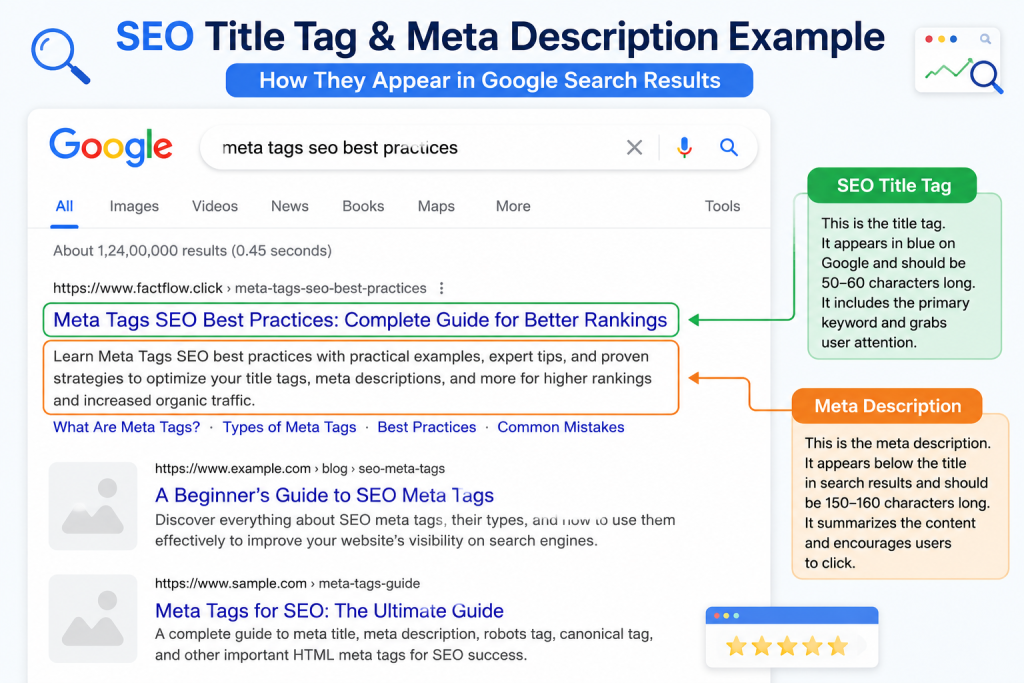
Conclusion
Meta tags remain one of the most valuable components of on-page SEO. Although they are only a small part of your website’s HTML, they play a significant role in helping search engines understand your content and encouraging users to click on your pages.
By following these Meta Tags SEO Best Practices, you can create stronger title tags, compelling meta descriptions, correctly configure robots and canonical tags, and improve how your content appears in search results and on social media. Combined with high-quality content and a good user experience, optimized meta tags support sustainable SEO growth.
Call to Action
Ready to improve your website’s SEO? Start optimizing your meta tags today, and if you need professional help, explore our Local SEO Services to boost your search visibility and attract more qualified traffic.