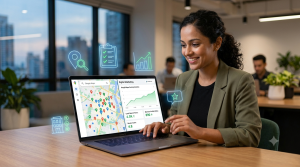
When someone searches “plumber near me” or “best tacos in [city],” the first thing they see isn’t a list of blue links — it’s a map with three pinned businesses. That’s the Local Pack, and it’s powered entirely by Google Maps SEO. If your business isn’t in it, you’re losing customers to competitors who show up first, even if your service is better.
This guide breaks down exactly how Google Maps ranks businesses in 2026, what you can actually control, and the steps that move a listing from page two to the top three. For a broader look at local search beyond Maps specifically, see our full local search optimization guide.
Quick Answer
Google Maps SEO is the process of optimizing your Google Business Profile and website so your business ranks higher in Google Maps results and the Local Pack (the 3-pack shown for “near me” and location-based searches). Google ranks Maps listings using three factors: relevance, distance, and prominence. Your primary category, review velocity, NAP consistency, and on-page local signals are the biggest levers you actually control.
Table of Contents
What Is Google Maps SEO?
Google Maps SEO is the practice of optimizing your business listing so it ranks higher in Google Maps search results and the Local Pack. It’s distinct from traditional website SEO: instead of optimizing a page to rank in organic listings, you’re optimizing an enriched business profile — categories, hours, reviews, photos, and attributes — that Google displays directly inside Maps and Search.
The stakes are high. A large share of local searches now end without a single click to a website — the searcher calls, gets directions, or messages the business directly from the Maps listing itself. That means your Google Business Profile frequently functions as your homepage, whether you intended it to or not.

How Google Maps Ranking Actually Works
Google’s own guidance confirms that local results are based on three factors:
- Relevance — how well your profile matches what someone is searching for.
- Distance — how close your business is to the searcher or the location implied in their search.
- Prominence — how well-known and trusted your business is, based on reviews, citations, backlinks, and engagement.
According to the Whitespark 2026 Local Search Ranking Factors report, the majority of the top ranking signals for the Local Pack and Maps come directly from the Google Business Profile itself — more than from your website, citations, or backlinks combined. That’s why GBP optimization is the highest-leverage activity for most businesses.
| Ranking Factor | What It Covers | Your Level of Control |
|---|---|---|
| Relevance | Primary/secondary category, services, business description | High |
| Distance | Physical address, service-area configuration | Partial |
| Prominence | Reviews, citations, backlinks, engagement (calls, directions, clicks) | High, but builds over time |

Claiming and Optimizing Your Google Business Profile
Claim and Verify
Go to business.google.com, search for your business, and claim it — or add it if no listing exists. Verification is typically completed by postcard, phone, email, or video, depending on your category and account history. Unverified profiles get significantly less visibility.
Choose the Narrowest Accurate Primary Category
Primary category is consistently identified as the single most important ranking factor for Google Maps. “Family Dentist” will outrank a generic “Dentist” listing for family-dentistry searches. Add relevant secondary categories, but don’t stretch into unrelated ones — Google can penalize category mismatches, and it’s flagged as a suspension risk.
Show Your Real Address (Even as a Service-Area Business)
If you have a genuine storefront, show it — Google’s algorithm favors businesses with a visible physical address in the city being searched. Service-area businesses without a public storefront should hide their address per Google’s guidelines and instead define precise service areas (up to 20), leaning more heavily on reviews and citations to build prominence.
Keep Descriptions and Services Detailed — Not Stuffed
Service descriptions should naturally include location modifiers (city, neighborhood) without keyword stuffing. Naming your business “Denver Plumber — Emergency AC Repair Denver” instead of your actual trading name is a common mistake that looks spammy and risks a suspension.
Upload Geotagged Photos Regularly
Photos with location metadata reinforce local relevance and function as an engagement signal. Weekly uploads of real photos — your storefront, team, and completed work — consistently outperform static profiles.
Reviews: The Prominence Multiplier
Reviews are one of the strongest prominence signals Google Maps evaluates. What matters most isn’t your total review count — it’s:
- Review recency — reviews from the last 30 days carry more weight than a large but stagnant total.
- Response rate — businesses that respond to the large majority of reviews, positive and negative, see a measurable ranking benefit.
- Rating consistency — a steady average rating across time builds more trust than a rating propped up by a single burst of reviews.
Build a repeatable process: ask for a review right after a positive interaction, respond to every review within a few days, and address negative reviews factually with a proposed resolution rather than ignoring them. If you want a structured way to check where your review and profile signals currently stand, our local SEO audit guide walks through exactly what to check first.
NAP Consistency and Citations
NAP (name, address, phone number) consistency acts like a trust contract between your website, your Google Business Profile, and every directory listing you appear on. Mismatched information — an old phone number on Yelp, a slightly different address format on a directory — weakens Google’s confidence in your listing and confuses customers.
Citations still matter beyond direct ranking weight, too. The Whitespark citation analysis found that the quality and authority of unstructured citations — mentions of your business on news sites, blogs, and industry directories — is now one of the top factors specifically for AI search visibility, not just traditional Maps rankings.
Your Website’s Role in Maps Rankings
Google uses your website as a supporting relevance and authority signal for your Maps listing — it isn’t optional just because your profile lives on Maps. Prioritize:
- LocalBusiness schema markup using JSON-LD, following Google’s structured data documentation, so your NAP and hours are unambiguous to search engines.
- An embedded Google Map on your contact page pointing to your verified listing.
- Dedicated service-location pages with unique, locally relevant content if you serve multiple neighborhoods or cities — not a templated page with the city name swapped.
- Mobile speed — mobile users click into Maps results considerably more often than desktop users, so a slow mobile experience directly costs you conversions.
If you’re a smaller operation trying to prioritize where to spend limited time, our local SEO for small business guide breaks down the highest-impact steps to start with.
Common Google Maps SEO Mistakes
| Mistake | Why It Hurts You |
|---|---|
| Keyword-stuffed business name | Violates Google’s guidelines and risks listing suspension |
| Incomplete profile (missing services, empty description) | Confuses Google about what your business actually offers |
| Outdated contact info or hours | Damages trust signals and loses customers in real time |
| Inconsistent NAP across platforms | Weakens Google’s confidence in your listing’s accuracy |
| Wrong or overly generic primary category | Misses high-intent searches your business should rank for |
| Treating optimization as a one-time task | Static profiles lose ground to competitors who stay active |
Google Maps SEO Checklist
- ☐ Claim and fully verify your Google Business Profile
- ☐ Select the narrowest accurate primary category
- ☐ Complete every profile field — services, attributes, description, hours
- ☐ Confirm NAP consistency across your website and top directories
- ☐ Add LocalBusiness schema markup to your website
- ☐ Upload geotagged photos weekly
- ☐ Set up a consistent review-request and response process
- ☐ Build dedicated location pages if you serve multiple areas
- ☐ Check mobile site speed and fix slow-loading pages
- ☐ Track rankings, calls, and direction requests monthly
How Long It Takes to Rank
Most businesses see measurable improvement within 60 to 90 days of implementing a comprehensive Google Maps SEO strategy, though highly competitive markets can take four to six months for significant gains. Category corrections can shift visibility within days, while review velocity and citation-building compound more gradually over the following weeks. Consistency matters more than any single fix — profiles that keep receiving fresh reviews, photos, and updates continue climbing, while those that go quiet tend to lose ground again.
Frequently Asked Questions
What is Google Maps SEO?
Google Maps SEO is the process of optimizing your Google Business Profile and website so your business ranks higher in Google Maps results and the Local Pack shown for location-based searches.
What’s the biggest ranking factor for Google Maps?
Your primary category is consistently identified as the single most important factor you can control, followed closely by review recency and response rate.
Can I rank on Google Maps without a physical storefront?
Yes. Service-area businesses can rank by hiding their address (per Google’s guidelines) and defining a clear service area, while leaning more heavily on reviews and citations to build prominence.
Do Google Business Profile posts affect Maps rankings?
Posts primarily improve engagement and click-through rate rather than directly moving your ranking position, but they contribute to the freshness signals that keep a profile looking active.
How is Google Maps SEO different from regular local SEO?
Google Maps SEO focuses specifically on your Google Business Profile and its ranking within Maps and the Local Pack, while local SEO more broadly includes on-page website optimization, content, and organic local rankings as well.
Does my website still matter if I have a strong Google Business Profile?
Yes. Google uses your website as a supporting signal for relevance and authority, and features like schema markup and location pages contribute directly to how your listing performs in Maps.
How often should I update my Google Business Profile?
Treat it as ongoing, not a one-time setup — weekly photo uploads and a steady flow of reviews outperform a profile that’s completed once and left untouched.
Can a wrong category get my listing suspended?
Selecting categories that don’t match your actual business, or mixing unrelated industries, is flagged as a suspension risk factor by Google, so accuracy matters more than breadth.
Conclusion
Google Maps SEO rewards businesses that treat their profile as an active channel, not a static listing. Get your primary category right, keep your NAP consistent everywhere it appears, build genuine review velocity, and back it up with a website that reinforces the same signals through schema and location pages. Do that consistently, and the map pack becomes a lot more reachable than it looks.
Not sure where your listing currently stands? Start with a full audit of your Google Business Profile and citations to find exactly what’s holding your rankings back.