If you run a business that depends on people nearby finding you — a dentist, a plumber, a coffee shop, a law firm — your content strategy can’t look like a national brand’s. You’re not trying to rank for “best running shoes.” You’re trying to be the answer when someone types “running shoe store near me” or “best trail shoes in Denver.” That’s a different game, and most local businesses play it with a national playbook that was never built for them.
This guide walks through how to actually build a local SEO content strategy that gets found in Google’s Local Pack, in AI Overviews, and in the regular map-and-links results people scroll through when they’re ready to buy. No filler, no theory for theory’s sake — just the framework, the content types that work, and the mistakes that quietly sink most local content plans.
Quick Answer: A local SEO content strategy combines three layers of content — core location/service pages, ongoing local-relevance content (guides, events, community topics), and a consistent Google Business Profile presence — all built around how real people in your area search, not generic keyword volume.
Definition: What Is a Local SEO Content Strategy?
A local SEO content strategy is a documented plan for creating and organizing website content — pages, posts, and profiles — so that search engines and AI answer systems associate your business with a specific geographic area and the services or products you offer there, in line with Google’s own local business guidelines. It goes beyond simply “adding a city name to a page.” It involves matching content to how nearby customers actually search, at each stage of their decision, and reinforcing that relevance signal consistently across your site and off-site listings.
Key Takeaways
- Local SEO content strategy is built on three pillars: location/service pages, local-relevance content, and profile optimization.
- Keyword research for local SEO should center on intent and neighborhood-level specificity, not just search volume.
- Google Business Profile posts and reviews function as content too — treat them with the same care as your website.
- Duplicate, thin location pages are one of the most common reasons local content fails to rank.
- Consistency (NAP, publishing cadence, review responses) matters more in local SEO than in most other SEO disciplines.
Table of Contents
- Why Local SEO Content Is Different From Regular SEO
- The Three Pillars of a Local SEO Content Strategy
- Local Keyword Research: Where to Start
- Step-by-Step: Building Your Strategy
- Local Content Types That Actually Rank
- Google Business Profile as a Content Channel
- Common Mistakes to Avoid
- Best Practices Checklist
- Local SEO vs. National SEO Content: A Comparison
- Frequently Asked Questions
Why Local SEO Content Is Different From Regular SEO
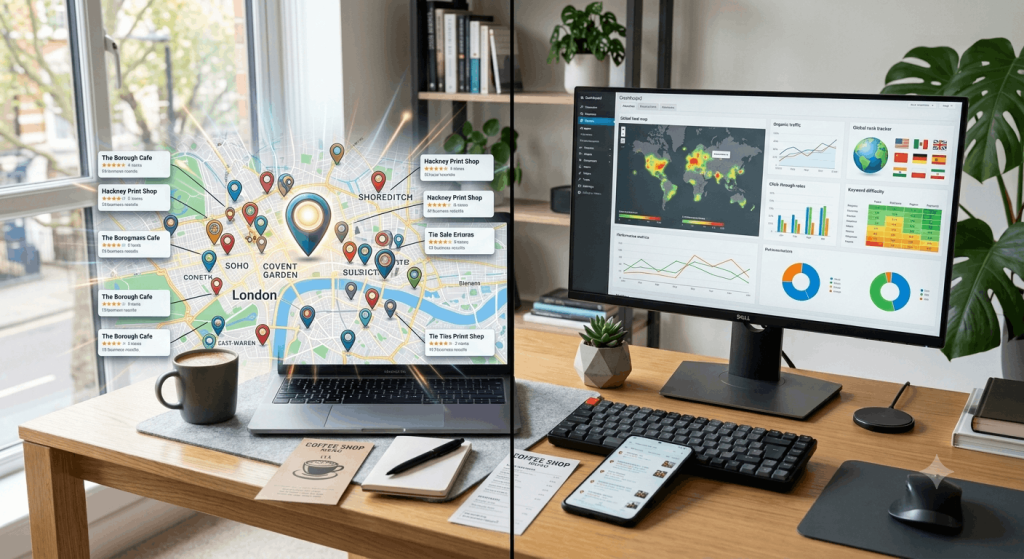
National SEO content optimizes for topical authority across a broad audience. Local SEO content optimizes for proximity relevance — Google (and increasingly AI-driven search) is trying to answer “what’s near me that solves this problem,” and that answer depends on your address, your service radius, your reviews, and how clearly your content signals where you actually operate.
This changes almost every decision in your content plan: which keywords matter, how many location pages you need, what “authority” even means for a local business, and how much weight off-page signals like reviews and citations carry compared to a purely national strategy.
The Three Pillars of a Local SEO Content Strategy
1. Core Location and Service Pages
These are the pages that directly answer “does this business serve my area, and can they do X?” If you serve multiple cities or neighborhoods, each deserves its own page — but only if you can write genuinely distinct, useful content for it. A page that’s identical to four others except for a swapped city name will struggle to rank and can actively hurt trust signals. If you want a deeper walkthrough of this specific pillar, see our guide to local search optimization.
2. Local-Relevance Content
This is your supporting content: guides, comparisons, local event coverage, “best of” roundups, and answers to questions your local customers actually ask. It builds topical depth and gives you something to link internally from your service pages, and something worth sharing or linking to from local community sites.
3. Profile and Listing Content
Your Google Business Profile description, posts, Q&A answers, and photos are content too — and for local search specifically, they’re some of the highest-leverage content you can produce. Consistency of your business name, address, and phone number (NAP) across your website and every directory listing reinforces the same signal. Consistency itself is worth auditing directly — our local citations SEO guide covers how to find and fix mismatched listings.
Local Keyword Research: Where to Start
Local keyword research starts the same way as any keyword research — understanding what your audience types — but with a geographic filter layered on top. A few practical starting points:
- Service + location combinations: “[service] in [city],” “[service] near [neighborhood].” Don’t stop at the city level if you serve distinct neighborhoods with different search behavior.
- Question-based local queries: “who is the best [profession] in [city],” “how much does [service] cost in [city].” These map well to AI Overview and featured snippet formats.
- “Near me” variants: These no longer need the literal words “near me” in your copy — Google infers proximity intent from device location — but they signal that people want a fast, clear answer about whether you’re close and available.
- Competitor and directory research: Look at what’s already ranking locally. It tells you what Google considers a satisfying answer for your area.
Avoid the trap of chasing high-volume national keywords for a business that only serves one metro area — you’ll be competing with pages you have no realistic chance of outranking, for traffic you can’t convert anyway. If your map pack visibility is part of the goal, it’s worth reading alongside our Google Maps SEO guide, since map rankings respond to a slightly different mix of signals than organic rankings.
Step-by-Step: Building Your Local SEO Content Strategy
- Audit your current footprint. List every page, listing, and profile that currently represents your business locally. Note inconsistencies in NAP data. Our local SEO audit guide walks through this step in detail if you want a structured checklist.
- Map your service area realistically. Only create dedicated location pages for areas you can genuinely serve and speak to with specific detail.
- Research intent by location. Search behavior can differ neighborhood to neighborhood — a downtown audience and a suburban audience may ask different questions of the same service.
- Build core service/location pages first. These are your money pages. Prioritize them over blog content.
- Layer in supporting content. Add guides, FAQs, and local resource content that link back to your core pages.
- Optimize and maintain your Google Business Profile. Treat it as a living content asset, not a one-time setup task.
- Build local citations and backlinks. Local newspapers, chambers of commerce, and community organizations are often more attainable and more relevant than generic guest posts. See our local citations SEO guide for a practical build-out process.
- Track rankings by geography. National rank trackers can hide local performance — use location-specific tracking where possible. For the broader traffic picture beyond rankings alone, our guide on increasing organic traffic is a useful companion read.
- Review and refresh quarterly. Local business details, hours, and offerings change more often than most content plans account for.
Local Content Types That Actually Rank
Location and Service-Area Pages
The backbone of the strategy. Each should include locally specific detail — landmarks, service-area boundaries, local regulations if relevant, and genuine customer proof from that area.
Local Guides and Resource Content
Example: a moving company publishing “Moving to [City]: A Neighborhood Guide” earns links and relevance beyond its direct service pages, while still supporting local intent.
Local Case Studies
A short write-up of a real local job or client (with permission) does double duty: it’s genuine EEAT-building proof of experience, and it naturally includes local terminology and specifics that generic content lacks.
Community and Event Content
Sponsoring or covering a local event, festival, or fundraiser gives you a natural reason to be mentioned and linked to by other local sites — something almost impossible to manufacture with generic content.
Local FAQs
Questions specific to operating in your area — permit requirements, local pricing norms, seasonal considerations — are exactly the kind of specific, useful detail that AI Overviews and featured snippets tend to surface.
Google Business Profile as a Content Channel
Many businesses treat their Google Business Profile as a one-time form to fill out. Treated as a content channel instead, it becomes an ongoing asset:
- Business description: Written for humans first, naturally including your core services and area.
- Posts: Regular updates — offers, events, new services — keep the profile active, which correlates with stronger local visibility.
- Q&A: Proactively seed and answer common questions before customers have to ask them elsewhere.
- Photos: Real, current photos of your location, team, and work outperform stock imagery for both trust and engagement.
- Reviews and responses: Thoughtful, specific responses to reviews are indexable content that reinforces service and location relevance.
If managing all of this in-house isn’t realistic for your team, our roundup of local SEO services for small businesses can help you evaluate outside help.
Common Mistakes to Avoid
- Duplicate “spun” location pages. Swapping the city name on an otherwise identical page is one of the fastest ways to waste effort and raise thin-content flags.
- Creating pages for areas you don’t really serve. This erodes trust and can trigger inconsistency between your content and your actual service radius.
- Inconsistent NAP data. A different phone number or address on one directory listing than on your website undermines the exact signal you’re trying to build.
- Ignoring reviews as content. Reviews and your responses to them are visible, indexable, and influence both rankings and conversion.
- Publishing once and abandoning it. Local relevance benefits from consistency — an active, current profile and content footprint outperforms a strong one-time push that goes stale.
Best Practices Checklist
- ☐ NAP consistent across website, Google Business Profile, and all directory listings
- ☐ Dedicated page for each genuinely served location or service area
- ☐ Each location page has unique, specific local content — not a template swap
- ☐ Core service pages linked internally from supporting blog/guide content
- ☐ Google Business Profile posted to regularly, not left static
- ☐ Reviews actively requested and thoughtfully responded to
- ☐ Local backlinks pursued from community organizations, local press, and partners
- ☐ Content reviewed and refreshed at least quarterly
- ☐ Rankings tracked by specific geography, not just overall averages
Local SEO vs. National SEO Content: A Comparison
| Factor | Local SEO Content | National SEO Content |
|---|---|---|
| Primary goal | Proximity + intent relevance | Topical authority at scale |
| Core keyword shape | Service + location, question-based | Broad, high-volume head terms |
| Key trust signals | NAP consistency, reviews, GBP activity | Backlink authority, domain-wide depth |
| Content volume needed | Lower, but highly specific | Higher, broader topical coverage |
| Update cadence priority | Frequent — hours, offers, local events change | Periodic — evergreen refresh cycles |
Frequently Asked Questions
How many location pages should a local business create?
Only as many as you can genuinely serve and write unique, specific content for. A tightly written page for three real service areas outperforms a templated page for fifteen.
Does a local SEO content strategy still need blog content?
Yes, but as a supporting layer. Blog and guide content builds topical depth and internal linking opportunities; it shouldn’t replace strong core service and location pages.
How long does it take to see results from local SEO content?
Timelines vary by competition and starting point, but meaningful movement in local rankings is typically measured in months, not weeks, especially for newer or lower-authority sites.
Is Google Business Profile part of content strategy or separate?
It should be treated as part of the same strategy. Its description, posts, and Q&A are content, and they influence local visibility alongside your website.
What’s the biggest local SEO content mistake small businesses make?
Publishing near-duplicate location pages with only the city name changed. It signals low effort and rarely ranks well.
Do reviews count as content for SEO purposes?
Reviews and business responses are publicly visible and indexable, and they reinforce the same location and service signals as your website content.
Should I target neighborhoods or just city-level keywords?
If your service area has distinct neighborhoods with different search behavior or competition, neighborhood-level content can be worthwhile — but only where you can back it with genuine local detail.
Conclusion
A strong local SEO content strategy isn’t about producing more content — it’s about producing the right content, organized around how people in your actual service area search and decide. Get the three pillars right — core location/service pages, supporting local-relevance content, and an actively maintained Google Business Profile — and you’re building something durable, not chasing rankings page by page.
Ready to put this into practice? Start with an audit of your current NAP consistency and location page coverage this week — it’s the fastest way to spot the gaps costing you visibility right now.